
Quarterly financial report for the quarter ended December 31, 2025
(unaudited)
ISSN 2817-2949
Cat. No. FD3-3E-PDF
1. Introduction
This quarterly report has been prepared by management as required by Section 65.1 of the Financial Administration Act, and in the form and manner prescribed by the Treasury Board in the Directive on Accounting Standards, GC 4400 Departmental Quarterly Financial Reports. This Quarterly Financial Report should be read in conjunction with the 2025–26 Main Estimates for the Financial Transactions and Reports Analysis Centre of Canada (FINTRAC).
This quarterly financial report has not been subject to an external audit or review.
1.1. Authority, mandate and program activities
FINTRAC (the Centre) is Canada’s financial intelligence unit and anti-money laundering and anti-terrorist financing regulator. The Centre assists in the detection, prevention and deterrence of money laundering and the financing of terrorist activities. FINTRAC's financial intelligence and supervision functions are a unique contribution to the safety of Canadians and the integrity of Canada's financial system.
FINTRAC acts at arm's length and is independent from the police services, law enforcement agencies and other entities to which it is authorized to disclose financial intelligence. It reports to the Minister of Finance, who is in turn accountable to Parliament for the activities of the Centre. FINTRAC’s headquarters are in Ottawa, with regional offices located in Montréal, Toronto, and Vancouver.
FINTRAC was established by, and operates within the ambit of, the Proceeds of Crime (Money Laundering) and Terrorist Financing Act and its Regulations. The Centre is one of several domestic partners in Canada’s Anti-Money Laundering and Anti-Terrorist Financing (AML/ATF) Regime, which is led by the Department of Finance.
FINTRAC fulfills its mandate by engaging in the following activities:
- Receiving financial transaction reports and voluntary information in accordance with the legislation and regulations;
- Safeguarding personal information under its control;
- Ensuring compliance of reporting entities with the legislation and regulations;
- Maintaining a registry of money services businesses in Canada;
- Producing financial intelligence relevant to investigations of money laundering, terrorist activity financing and threats to the security of Canada;
- Researching and analyzing data from a variety of information sources that shed light on trends and patterns in money laundering and terrorist activity financing; and
- Enhancing public awareness and understanding of money laundering and terrorist activity financing.
In addition, FINTRAC is part of the Egmont Group, an international network of financial intelligence units (FIU) that collaborate and exchange information to combat money laundering and terrorist activity financing. FINTRAC also contributes to other multilateral fora such as the Financial Action Task Force (FATF), the Asia-Pacific Group on Money Laundering (APG) and the Caribbean Financial Action Task Force (CFATF), participating in international policy making and the provision of technical assistance to other FIUs.
The description of the program activities for the Centre can be found in Part II of the 2025–26 Main Estimates and in the 2025–26 Departmental Plan.
1.2. Basis of presentation
This quarterly report has been prepared by management using an expenditure basis of accounting. The accompanying Statement of Authorities includes the Centre’s spending authorities granted by Parliament, and those used by the Centre consistent with the Main Estimates and Supplementary Estimates for the 2025–26 fiscal year. This quarterly report has been prepared using a special purpose financial reporting framework designed to meet financial information needs with respect to the use of spending authorities.
The authority of Parliament is required before money can be spent by the Government. Approvals are given in the form of annually approved limits through appropriation acts, or through legislation in the form of statutory spending authority for specific purposes.
FINTRAC uses the full accrual method of accounting to prepare and present its annual departmental financial statements that are part of the departmental results reporting process. However, the spending authorities voted by Parliament remain on an expenditure basis.
2. Highlights of fiscal quarter and fiscal year-to-date (YTD) results
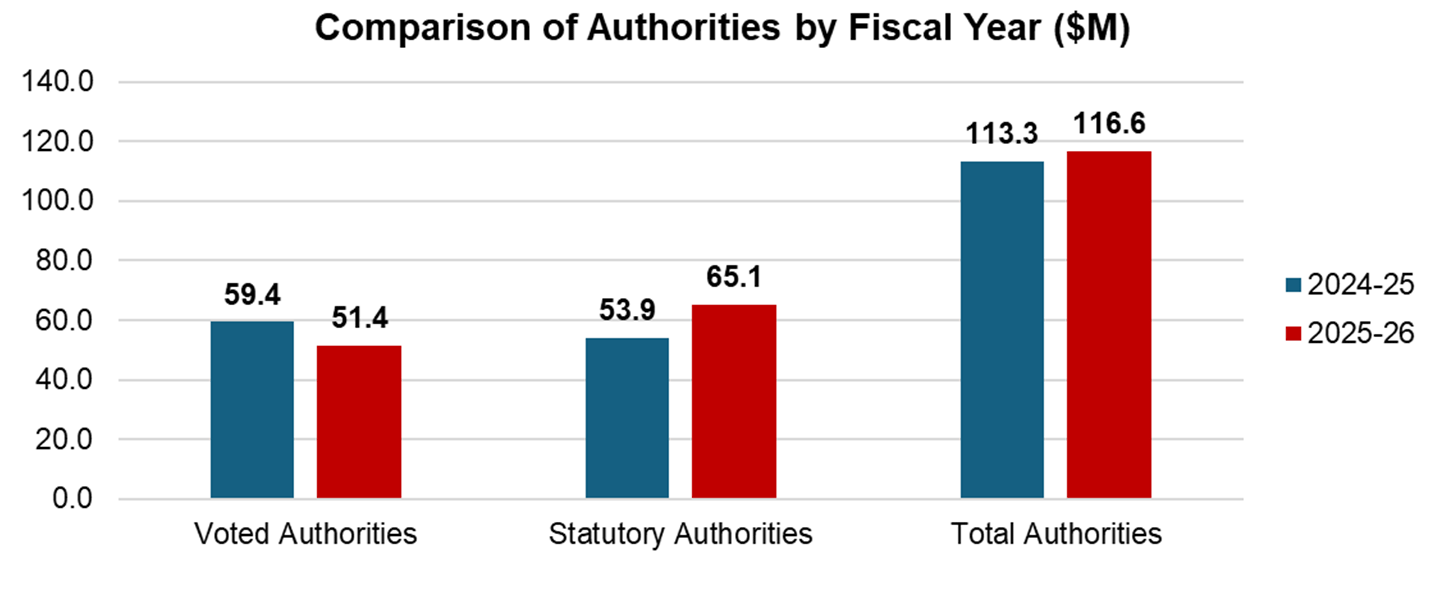
This departmental quarterly financial report reflects the results of the current fiscal period. The following graph provides a comparison of voted and statutory authorities available for the first nine months of 2025–26 compared to 2024–25.
2.1. Authorities analysis
The following table provides a comparison of cumulative authorities by vote for the current and previous fiscal year.
| Authorities available ($ thousands) | 2025–26 | 2024–25 | Variance ($) | Variance (%) |
|---|---|---|---|---|
| Voted | ||||
| Vote 1 - Program expenditures | 51,434 | 59,366 | -7,932 | -13% |
| Statutory | ||||
| Payments under Section 50.1 of the Proceeds of Crime (Money Laundering) and Terrorist Financing Act | 60,507 | 49,362 | 11,145 | 23% |
| Employee benefits plan | 4,625 | 4,557 | 68 | 1% |
| Total authorities | 116,566 | 113,285 | 3,281 | 3% |
The total voted and statutory authorities available as at December 31, 2025 are $116.6M compared to $113.3M for the same period in 2024–25. This is an increase of $3.3M (or 3%). This is primarily due to the increased cost and the continued investments to the Compliance program, offset by sunsetting funding received in Budget 2020 and Budget 2022 in addition to a lower operating budget carry forward (OBCF) from 2024–25 into 2025–26.
2.1.1. Voted budgetary authorities
| Authorities available ($ thousands) | 2025–26 | 2024–25 | Variance ($) | Variance (%) |
|---|---|---|---|---|
| Vote 1 - Program expenditures | 51,434 | 59,366 | -7,932 | -13% |
The total voted budgetary authorities available as at December 31, 2025 are $51.4M compared to $59.4M for the same period in 2024–25. The decrease of approximately $7.9M (or -13%) is primarily due to the sunsetting of funding received in Budget 2020 and Budget 2022, combined with a lower operating budget carry forward (OBCF) from 2024–25 into 2025-26.
2.1.2. Statutory budgetary authorities
| Authorities available ($ thousands) | 2025–26 | 2024–25 | Variance ($) | Variance (%) |
|---|---|---|---|---|
| Payments under Section 50.1 of the Proceeds of Crime (Money Laundering) and Terrorist Financing Act | 60,507 | 49,362 | 11,145 | 23% |
| Employee benefits plan | 4,625 | 4,557 | 68 | 1% |
| Total statutory authorities | 65,132 | 53,919 | 11,213 | 21% |
The total statutory budgetary authorities available as at December 31, 2025 are $65.1M compared to $53.9M for the same period in 2024–25. The increase of $11.2M (or 21%) is primarily driven by ongoing investments to modernize the Compliance program. This includes the shift in funding profile of Budget 2024 which includes both voted and statutory budgetary authorities from 2025–26 onward as the initiative transitions to support activities across FINTRAC.
2.2. Expenditure analysis
The following table provides a comparison of year-to-date spending at December 31, 2025 for the current and previous fiscal years.
| Year to date expenditures ($ thousands) | 2025–26 | 2024–25 | Variance ($) | Variance (%) |
|---|---|---|---|---|
| Voted | ||||
| Vote 1 - Program expenditures | 29,368 | 35,613 | -6,245 | -18% |
| Statutory | ||||
| Payments under Section 50.1 of the Proceeds of Crime (Money Laundering) and Terrorist Financing Act | 30,127 | 27,356 | 2,771 | 10% |
| Employee benefits plan | 3,469 | 3,357 | 112 | 3% |
| Year to date expenditures | 62,964 | 66,326 | -3,362 | -5% |
Total budgetary voted and statutory expenditures at December 31, 2025 are $63M in 2025–26 compared to $66.3M for the same period in 2024–25, a decrease of $3.4M (or 5%). This decrease is primarily attributed to a reduction in personnel costs.
3. Risks and uncertainties
As Canada’s financial intelligence unit and a partner in Canada’s AML/ATF Regime, FINTRAC operates in a dynamic, constantly changing environment. In seeking to identify risks and opportunities proactively, FINTRAC must anticipate and assess internal and external risk factors that may affect the design and delivery of its programs and the achievement of its strategic objectives. Additionally, FINTRAC must identify factors and risks that could adversely affect its ability to manage its resources effectively.
FINTRAC maintains a Corporate Risk Profile (CRP) to identify and manage its key corporate risks. The development of the CRP is a self-assessment process to identify, validate and measure risks where action or intervention can improve results or prevent harm. Senior level committees review the CRP, and the business planning process identifies activities to mitigate the risks. The objective of the CRP is to create information that FINTRAC managers and decision-makers can use when planning and setting priorities.
3.1. Risk factors and mitigation
FINTRAC remains vigilant in anticipating and preparing for risks, situations, and events that impact its operational environment. The Centre is making significant strides in advancing its modernization vision to ensure the Centre is well positioned to address the emerging threats in Canada's AML/ATF landscape, with a focus on developing skills, refining processes, and integrating advanced technologies to enable real-time operations.
It is expected that there will be increasing pressures in operating budget authorities over the next fiscal years as new measures are announced to ensure the effective operation of federal government programs and services, and to ensure that Canadians' tax dollars are being used efficiently on the programs that matter most to them. FINTRAC has heeded this call and is actively looking at ways to lean its operations and become more efficient while delivering value for Canadians.
Given the implementation of FINTRAC’s assessment of expenses funding model, prescribed reporting entities (RE) regulated under the Proceeds of Crime (Money Laundering) and Terrorist Financing Act pay an annual assessment to cover the costs of the compliance function of the Centre. There is an inherent risk associated with collections, similar to any accounts receivable process. FINTRAC will routinely review and evaluate the effectiveness and efficiency throughout its maturity.
4. Significant changes in relation to operations, personnel and programs
4.1. Key personnel changes
Jessica Kaluski, FINTRAC’s Chief Financial Officer (CFO) and Assistant Director for the COP sector, retired in December 2025.
Philippe Blanchette, Chief Human Resource Officer (CHRO) and Assistant Director of the People, Culture and Workplace Sector has taken on an expanded leadership role as an interim measure by serving concurrently as both CHRO and interim CFO as of October 20th, 2025.
5. Approval by senior officials
Approved by:
Philippe Blanchette, Acting Chief Financial Officer (A/CFO)
Date: February 25, 2026
Sarah Paquet, Director and Chief Executive Officer
Date: February 26, 2026
| Fiscal year 2025–26 | Fiscal year 2024–25 | |||||
|---|---|---|---|---|---|---|
| Budgetary authorities | Total available for use for the year ending March 31, 2026Footnote * | Used during the quarter ended December 31, 2025 | Year to date used at quarter end | Total available for use for the year ending March 31, 2025Footnote * | Used during the quarter ended December 31, 2024 | Year to date used at quarter end |
| Voted | ||||||
| Vote 1 - Program expenditures | 51,434 | 9,402 | 29,368 | 59,366 | 14,426 | 35,613 |
| Statutory | ||||||
| Compliance and related activities | 60,507 | 11,422 | 30,127 | 49,362 | 9,852 | 27,356 |
| Employee benefits plan | 4,625 | 1,156 | 3,469 | 4,557 | 2,112 | 3,357 |
| Total authorities | 116,566 | 21,980 | 62,964 | 113,285 | 26,390 | 66,326 |
| Fiscal year 2025–26 | Fiscal year 2024–25 | |||||
|---|---|---|---|---|---|---|
| Planned expenditures for the year ending March 31, 2026 | Expended during the quarter ended December 31, 2025 | Year to date used at quarter end | Planned expenditures for the year ending March 31, 2025 | Expended during the quarter ended December 31, 2024 | Year to date used at quarter end | |
| Expenditures | ||||||
| Personnel | 76,729 | 15,676 | 46,988 | 73,758 | 18,220 | 50,417 |
| Transportation and communications | 1,313 | 242 | 1,328 | 1,056 | 222 | 1,118 |
| Information | 969 | 67 | 331 | 937 | 128 | 385 |
| Professional and special services | 22,005 | 2,602 | 5,938 | 17,766 | 1,852 | 5,427 |
| Rentals | 10,122 | 2,904 | 6,612 | 13,794 | 3,738 | 5,030 |
| Purchase, repair and maintenance | 688 | -3 | 286 | 2,341 | 102 | 789 |
| Utilities, materials and supplies | 181 | 114 | 204 | 201 | 83 | 160 |
| Acquisition of land, buildings and works | 0 | 0 | 0 | 0 | 0 | 0 |
| Acquisition of machinery and equipment | 4,532 | 209 | 1,012 | 3,428 | 2,033 | 2,892 |
| Transfer payments | 0 | 0 | 0 | 0 | 0 | 0 |
| Public debt charges | 21 | 0 | 0 | 0 | 0 | 12 |
| Other | 6 | 114 | 264 | 4 | 12 | 96 |
| Total budgetary expenditures | 116,566 | 21,925 | 62,963 | 113,285 | 26,390 | 66,326 |
- Date Modified: