
Financial Transactions and Reports Analysis Centre of Canada's 2026–27 Departmental plan
On this page
- At a glance
- From the Director and Chief Executive Officer
- Plans to deliver on core responsibilities and internal services
- Department-wide considerations
- Planned spending and human resources
- Supplementary information tables
- Federal tax expenditures
- Corporate information
- Definitions
Copyright information
© His Majesty the King in Right of Canada, as represented by the Minister of Finance and National Revenue, 2026, ISSN: 2371-5944
At a glance
This departmental plan details FINTRAC’s priorities, plans, and associated costs for the upcoming three fiscal years.
These plans align with the priorities outlined in the Mandate Letter, as well as FINTRAC’s Vision, mission, raison d’être and operating context.
Key priorities
In 2026–27, FINTRAC is advancing with strategic clarity and is focused on the following three priorities:
- Delivering on its core mandate and making contributions to broader national priorities
- Optimizing and modernizing its resources and processes
- Strengthening its organizational culture
These priorities are integral to the Centre’s mission of safeguarding Canada's financial system, supporting its partners and stakeholders, and helping to protect Canadians. FINTRAC’s over-arching modernization vision is fundamental to delivering on these priorities, as well as to transform the Centre to meet the challenges of the future and drive efficiency.
Comprehensive expenditure review
The government is committed to restraining the growth of day-to-day operational spending to make investments that will grow the economy and benefit Canadians.
As part of meeting this commitment, FINTRAC is planning the following spending reductions:
- 2026–27: $3,289,000
- 2027–28: $4,385,000
- 2028–29: $6,578,000
It is anticipated that these spending reductions will involve a decrease of approximately 33 full-time equivalents by 2028–29.
FINTRAC will achieve these reductions by doing the following:
- Streamlining operational costs across key functions
- Workforce optimization – Strategic and operational support functions
- Refocusing IM/IT resources for core deliverables
- Strategic partnership, policy and analysis resource alignment
The figures in this departmental plan reflect these reductions.
Highlights for FINTRAC in 2026–27
In the fiscal year 2026–27, FINTRAC will embark on the following key priorities:
Deliver on FINTRAC’s core mandate
- FINTRAC’s key priority is to deliver on its core mandate. This includes excelling in its core operational and strategic business, supporting urgent national priorities such as strengthening support for the Joint Operational Intelligence Cell (JOIC) and other border initiatives by sustaining rapid and high-volume disclosures on fentanyl and synthetic opioids, and complying with all Government of Canada policy and legal requirements. To achieve this priority, FINTRAC is reinforcing its foundations by enhancing cyber security, stabilizing critical infrastructure, and modernizing operations through new technology and transforming the Supervisory Framework to support businesses subject to the Proceeds of Crime (Money Laundering) and Terrorist Financing Act (the Act) and associated Regulations.
Optimize and modernize resources and processes
- FINTRAC’s second priority is to optimize and modernize resources and processes to thrive in a rapidly evolving technological landscape. This involves strengthening the Centre’s workforce through skills development, embracing innovation and modern technologies, and improving the efficiency of existing business processes. The Centre will strive to continuously improve the effectiveness and efficiency of its activities, particularly its supervisory activities, by leveraging technology and evolving FINTRAC’s risk-based supervisory approach to meet the challenges of a dynamic financial landscape and ensure a more streamlined and predictable compliance experience for businesses. As we continue to mature and advance our innovation journey, we anticipate that future efficiencies will play a pivotal role in shaping how we deliver on expected results.
Strengthening organizational culture
- FINTRAC’s third priority is to strengthen its organizational culture. This will be achieved by promoting security awareness across the organization, developing leadership at all levels, and reinforcing a shared identity rooted in the Centre’s strong commitment to its mandate, supporting partners, and serving and protecting Canadians. The objective is to foster a healthy, resilient and high-performing workforce that positions FINTRAC for sustainable success at a time of rapid change and uncertainty.
In 2026–27, total planned spending (including internal services) for FINTRAC is $137,177,443 and total planned full-time equivalent staff (including internal services) is 581.
Summary of planned results
The following provides a summary of the results FINTRAC plans to achieve in 2026–27 under its main areas of activity, called “core responsibilities.”
Core responsibility 1: Compliance with Anti-Money Laundering and Anti-Terrorism Financing Legislation and Regulations
In 2026–27, FINTRAC will undertake the following major activities:
FINTRAC will reinforce its supervisory program to ensure businesses meet their anti-money laundering and anti-terrorist financing obligations, protecting Canadians and safeguarding the integrity of Canada’s financial system. This will include proactive early interventions and the full use of supervisory tools, including stronger administrative monetary penalties where warranted and disclosures of serious non-compliance to law enforcement for potential criminal investigations.
FINTRAC will also focus on developing and implementing its revised and comprehensive risk and supervisory framework, guided by a sophisticated, risk-based approach that is informed by the highest risks identified in the 2025 Assessment of Money Laundering and Terrorist Financing Risks in Canada. Supported by modernized systems and a centralized reporting entity portal, this approach will simplify interactions with businesses, provide real-time guidance and updates, and reduce uncertainty and administrative effort. Clearer expectations and faster interventions will enhance transparency and efficiency across the regime. Lastly, to ensure businesses and Canadians remain informed about emerging threats, FINTRAC will continue producing public-facing strategic intelligence on evolving trends, typologies, and indicators of money laundering, terrorist financing, and sanctions evasion. This will allow businesses to better detect and respond to suspicious and high-risk transactions, strengthening Canada’s collective resilience.
Planned spending: $85,318,027
Planned human resources: 356
More information about Compliance with Anti-Money Laundering and Anti-Terrorism Financing Legislation and Regulations can be found in the full plan.
Core responsibility 2: Production and dissemination of financial intelligence
In 2026–27, FINTRAC will undertake the following major activities:
FINTRAC will focus on generating actionable, timely and accurate financial intelligence that supports national priorities informed by the 2025 Assessment of Money Laundering and Terrorist Financing Risks in Canada including combatting money laundering associated with fentanyl and other illicit drug trafficking, fraud, trade-based and professional money laundering, human trafficking, transnational organized crime, terrorism financing and threats to the security of Canada, while protecting the personal information entrusted to FINTRAC.
The Centre will also produce strategic financial intelligence on a similar range of specific money laundering, terrorist financing, sanctions evasion and national security threat financing trends, typologies and financial transaction channels – such as virtual assets, shell companies and charities – to improve the detection, prevention and deterrence of illicit activities by AML/ATF Regime members in law enforcement, national security, and policy development.
These assessments, reports and tactical disclosure operations will be informed by the 2025 Assessment of Money Laundering and Terrorist Financing Risks in Canada. The Centre will deepen the generation of intelligence notices from strategic intelligence to inform supervision and disclosure operations.
Planned spending: $35,947,874
Planned human resources: 156
More information about Production and dissemination of financial intelligence can be found in the full plan.
For complete information on FINTRAC’s total planned spending and human resources, read the Planned spending and human resources section of the full plan.
From the Director and Chief Executive Officer

I am pleased to present to Parliament the 2026–27 Departmental Plan for the Financial Transactions and Reports Analysis Centre of Canada (FINTRAC). This report sets out our priorities and describes our plans for achieving real and impactful results for our partners and for Canadians in the upcoming year.
FINTRAC is at the heart of Canada’s multi-agency Anti-Money Laundering and Anti-Terrorist Financing (AML/ATF) Regime. By ensuring that approximately 38,000 businesses comply with their regulatory obligations and in generating critical financial intelligence for Canada’s law enforcement and national security agencies, the Centre plays a key role in combatting money laundering, terrorist financing, sanctions evasion and other threats to the security of Canada.
With transnational organized criminals and terrorists using increasingly sophisticated methods and technology to exploit vulnerabilities and inflict harm, we are focused on delivering on our core mandate, which is centered on protecting Canadians and Canada’s financial system. Our financial intelligence will be essential to advancing key national priorities in the coming year, including combatting extortion, illegal fentanyl, cyber-enabled fraud, auto theft and human trafficking. Our financial intelligence will also be crucial to the federal government’s enhanced efforts to secure Canada’s border and increased focus on fighting financial crime, particularly with the creation of Canada’s new financial crimes agency. In the coming months, we will be seeking additional resources to augment our financial intelligence operations and assistance in support of the federal government’s robust ‘follow the money’ strategy to combat financial crime.
In 2026–27, to help protect Canada’s financial system and Canadian businesses that are under increasing threat from transnational organized crime, we will intensify our supervisory efforts through a comprehensive risk-based approach that prioritizes the highest threats identified in Canada’s 2025 Assessment of Money Laundering and Terrorist Financing Risks. In operationalizing our new risk and supervisory framework, we will sharpen our focus on the priorities that matter most to advancing key national priorities and protecting Canada and Canadians. This will include enhancing our supervision of financial institutions, expanding oversight of virtual currency activities to address the risks in this rapidly evolving sector, and deepening our understanding of the money laundering risks in the online gaming space to mitigate vulnerabilities associated with the growth of illegal gaming and gambling platforms across Canada.
In the coming year, we will also implement comprehensive legislative and regulatory changes aimed at strengthening the impact of our supervisory activities and protecting Canada’s financial system. This includes introducing a streamlined universal enrolment program for regulated entities, advancing FINTRAC’s leadership role within the Financial Institutions Supervisory Committee (FISC) and the Strategic Advisory Committee (SAC), and strengthening the enforcement framework for administrative monetary penalties. With the significant changes to our Administrative Monetary Penalties Program, we will concentrate our efforts on entities that are not fulfilling their legal obligations and putting Canada and Canadians at risk. Combatting money laundering, terrorist financing and sanctions evasion is a moral and social responsibility, and we will ensure that businesses are doing their part.
As we enhance our supervisory efforts in the coming year, we will also accelerate our digital transformation by deploying cutting-edge technological solutions and modernizing existing applications to meet the demands of heightened oversight and evolving regulatory requirements. Central to this initiative is the development of a next-generation reporting entity portal, which will deliver streamlined reporting, real-time guidance, timely regulatory updates and integrated money services business registration and universal enrolment.
The digital transformation of our supervisory efforts is closely aligned with our broader real-time modernization vision. With this vision, we are advancing FINTRAC-wide digital automation, exploring artificial intelligence and machine learning, and pioneering data analytics to strengthen our financial intelligence and supervisory programs and better protect Canada and Canadians. For example, in combatting online child sexual exploitation, real-time financial intelligence capabilities will allow us to proactively identify and assist law enforcement, both in Canada and abroad, in disrupting networks that produce and distribute child sexual abuse material much quicker. This means that law enforcement can rescue victims sooner, support survivors earlier, and help all agencies target perpetrators faster, preventing the abuse of new victims. This is the essence of our work—helping to protect Canada’s most vulnerable citizens.
In 2026–27, we will also continue to work closely with our partners within Canada's AML/ATF Regime to ensure our overall Regime aligns well with domestic and international priorities and best practices. We look forward to the report of the Financial Action Task Force (FATF) mutual evaluation of Canada's AML/ATF Regime in mid-2026 and the review of the Office of the Auditor General of Canada. We will welcome any helpful recommendations that will assist in strengthening our ability to deliver results for Canadians.
I want to recognize and thank FINTRAC's dedicated employees for their professionalism, expertise, and unwavering commitment. I am proud to work with such capable professionals who are recognized here in Canada and internationally for their knowledge, expertise and commitment to the global fight against money laundering and the financing of terrorist activities.
______________________________
Sarah Paquet
Director and Chief Executive Officer
Plans to deliver on core responsibilities and internal services
Core responsibilities and internal services
- Core responsibility 1: Compliance with Anti-Money Laundering and Anti-Terrorism Financing Legislation and Regulations
- Core responsibility 2: Production and dissemination of financial intelligence
- Internal services
Core responsibility 1: Compliance with Anti-Money Laundering and Anti-Terrorism Financing Legislation and Regulations
In this section
Description
FINTRAC is responsible for ensuring compliance with Part 1 and Part 1.1 of the Proceeds of Crime (Money Laundering) and Terrorist Financing Act (PCMLTFA) and its associated Regulations. This legal framework establishes obligations for reporting entities to develop and implement a compliance program to identify clients, monitor business relationships, keep records and report certain types of financial transactions. FINTRAC undertakes enabling and enforcement actions to ensure that the reporting entities operating within Canada's financial system fulfill their PCMLTFA obligations. These obligations provide important measures for countering patterns and behaviours observed in criminals and terrorists to deter them from operating within the legitimate channels of Canada's economy. FINTRAC also maintains a registry of money services businesses in Canada and foreign money services businesses that direct and provide services to persons and entities in Canada.
Quality of life impacts
This core responsibility contributes to the Society and Good Governance domains of the Quality of Life Framework for Canada. More specifically, it contributes to the Central indicators of Life satisfaction and Future outlook, and the Trust in others, Confidence in institutions and Crime Severity Index indicators.
Indicators, results and targets
This section presents details on the department’s indicators, the actual results from the three most recently reported fiscal years, the targets and target dates for Compliance with Anti-Money Laundering and Anti-Terrorism Financing Legislation and Regulations. Details are presented by departmental result.
Table 1: Reporting entities are compliant with Anti-Money Laundering and Anti-Terrorist Financing obligations and requirements
Table 1 provides a summary of the target and actual results for each indicator associated with the results under Compliance with Anti-Money Laundering and Anti-Terrorism Financing Legislation and Regulations.
| Departmental result indicators | Actual results | 2026–27 Target | Date to achieve target |
|---|---|---|---|
| Percentage of assessed reporting entities not requiring enforcement actionFootnote 1 | 2022–23: 95% 2023–24: 89% 2024–25: 85% |
90% | March 31, 2027 |
| Percentage of financial transaction reports submitted to FINTRAC that meet validation rules as an indicator of quality | 2022–23: 90% 2023–24: 70%Footnote 2 2024–25: Not availableFootnote 3 |
90% | March 31, 2027 |
Additional information on the detailed results and performance information for the FINTRAC’s program inventory is available on GC InfoBase.
Plans to achieve results
The following section describes the planned results for Compliance with Anti-Money Laundering and Anti-Terrorism Financing Legislation and Regulations in 2026–27.
Reporting entities are compliant with Anti-Money Laundering and Anti-Terrorist Financing obligations and requirements
As part of its core mandate, FINTRAC administers a comprehensive, risk-based supervision program to ensure that businesses fulfill their obligations under the Act and associated Regulations. These obligations allow for certain economic activities to be more transparent, which helps deter criminals and terrorists from using Canada's financial system to launder the proceeds of their crimes, finance terrorist activities or evade sanctions.
Central to FINTRAC's risk-based approach are a host of activities aimed at ensuring that Canadian businesses—both domestic and international—understand and comply with their 'know-your-client' and record keeping requirements, and that they submit high quality and timely reports to FINTRAC. Efforts made by business to meet these requirements are fundamental to the detection, deterrence and prevention of money laundering, terrorist financing, and sanctions evasion. Moreover, these obligations are central to the Government of Canada’s strategy to mitigate financial crime risks and meet global standards.
FINTRAC’s Supervision sector plays a critical role in supporting and shaping compliance through three interconnected pillars: monitoring compliance through a risk-based supervisory approach, enforcing obligations through tools such as administrative monetary penalties and non-compliance disclosures to law enforcement, and engaging reporting entities with tailored outreach and sector-specific guidance. Together, these efforts promote behavioural change, enhance operational integrity, and reinforce Canada’s collective capacity to detect, deter and disrupt financial crime.
Businesses must similarly be well placed to recognize and detect changes in the money laundering, terrorist activity financing and sanctions evasion environment. Complementary to the operational components of the Supervision program, FINTRAC and its strategic intelligence function plays a critical role in supporting the awareness and understanding of businesses subject to the Act about key trends and developments, as well as emerging typologies and indicators, through the publication of special bulletins, operational alerts and other types of strategic intelligence material. This will allow businesses to better identify and take action in relation to suspicious and high-risk transactions in order to protect Canadians and safeguard Canada's financial system.
To effectively evolve the compliance framework towards a supervisory one requires the right suite of policies and procedures, supported by the right systems and training mechanisms, together with a capacity to change within a complex and dynamic operating environment.
Results we plan to achieve
In 2026–27, FINTRAC will undertake the following major activities:
- Accelerate the digital transformation of FINTRAC’s Supervision program by developing an initial deployment of cutting-edge technological solutions and modernizing existing applications to meet the demands of heightened oversight and evolving regulatory requirements. Harness innovation to continuously enhance the effectiveness and efficiency of supervisory activities, leveraging advanced tools and a refined risk-based approach to navigate an increasingly complex financial ecosystem. Central to this initiative is the development of a next-generation Reporting Entity Portal—delivering streamlined reporting, real-time guidance, timely regulatory updates and integrated MSB registration and universal enrolment. By improving data quality and automating processes, FINTRAC will close compliance gaps, enable proactive risk management, and position the Centre as a forward-thinking leader in supervision.
- Intensify FINTRAC’s supervisory efforts through a comprehensive, risk-based approach that prioritizes the highest threats identified in Canada’s 2025 Assessment of Money Laundering and Terrorist Financing Risks. By operationalizing its new risk and supervisory framework, FINTRAC will sharpen its focus on the priorities that matter most—disrupting fentanyl trafficking, dismantling organized crime, and mitigating insider threats—while staying ahead of emerging risks and typologies through targeted reviews, enhanced interventions, and forward-looking modernization efforts. This approach will:
- strengthen FINTRAC’s supervision of financial institutions to ensure actions are vigilant, adaptive, and responsive to evolving vulnerabilities,
- expand intrusive and technologically advanced oversight of virtual currency activities to address risks in this rapidly evolving sector, and
- deepen FINTRAC’s understanding of money laundering risks in online gaming to implement targeted measures that mitigate vulnerabilities associated with the growth of illegal gaming and gambling platforms across Canada.
- At the same time, FINTRAC will embed insights from the 2025 Assessment into sector-level and entity-level risk intelligence, advancing its Regulated Entity Risk Index (RERI) as the cornerstone for transforming vast, multi-source data into sharp, actionable supervision priorities.
- With FINTRAC’s new risk and supervisory framework driving modernization, scale up oversight of newly regulated entities and legislative requirements by building supervisory capacity across emerging sectors. At the same time, the Centre is strengthening sanctions compliance and beneficial ownership supervision to align with evolving laws and priorities—ensuring reporting entities not only understand their obligations but consistently meet them under Canada’s AML/ATF regime.
- Drive readiness for evolving legislative and regulatory landscapes by shaping and executing forward-looking programs that elevate the impact and efficiency of supervisory activities. Key priorities include strengthening the enforcement framework for administrative monetary penalties, introducing a streamlined universal enrolment program for regulated entities, and advancing FINTRAC’s leadership role within the Financial Institutions Supervisory Committee (FISC) and the Strategic Advisory Committee (SAC).
- Act on findings from upcoming audits and Canada’s FATF mutual evaluation to keep FINTRAC’s supervision program transparent, sustainable, and globally aligned. By embedding recommendations into its risk-based framework, FINTRAC will strengthen its ability to address evolving threats and uphold international credibility. At the same time, it will deepen partnerships with domestic agencies and global bodies like the FATF and Egmont Group to drive best practices, influence policy, and lead joint efforts against cross-border financial crime.
- Deliver and amplify strategic intelligence to the private sector, grounded in the threats, vulnerabilities, and risks identified in the 2025 Assessment of Money Laundering and Terrorist Financing Risks in Canada. Equip businesses with actionable insights to strengthen detection, prevention, and deterrence of money laundering, terrorist financing, and sanctions evasion—empowering them to stay ahead of emerging threats and safeguard the integrity of Canada’s financial system.
Planned resources to achieve results
Table 2: Planned resources to achieve results for Compliance with Anti-Money Laundering and Anti-Terrorism Financing Legislation and Regulations
Table 2 provides a summary of the planned spending and full-time equivalents required to achieve results.
| Resource | Planned |
|---|---|
| Spending | $85,318,027 |
| Full-time equivalents | 356 |
Complete financial and human resources information for the FINTRAC’s program inventory is available on GC InfoBase.
Program inventory
Compliance with Anti-Money Laundering and Anti-Terrorism Financing Legislation and Regulations is supported by the following programs:
- Supervision program
Additional information related to the program inventory for Compliance with Anti-Money Laundering and Anti-Terrorism Financing Legislation and Regulations is available on the Results page on GC InfoBase.
Summary of changes to reporting framework since last year
FINTRAC’s Compliance program has been renamed the Supervision program and includes the results and resources of both the former Compliance program and the former Strategic Policy and Reviews program. It should be noted that the Supervision program includes components of FINTRAC’s strategic intelligence activities that are designed to support businesses in meeting their obligations under the Act.
Core responsibility 2: Production and dissemination of financial intelligence
In this section
Description
FINTRAC is mandated by the Proceeds of Crime (Money Laundering) and Terrorist Financing Act (PCMLTFA) to produce actionable financial intelligence that assists Canada's police, law enforcement, national security and other international and domestic partner agencies in combatting money laundering, terrorism financing and threats to the security of Canada, while protecting the personal information entrusted to FINTRAC. The Centre also produces strategic financial intelligence for federal policy and decision-makers, the security and intelligence community, reporting entities across the country, international partners and other stakeholders. FINTRAC’s strategic intelligence provides a wide analytical perspective on the nature, scope and threat posed by money laundering and terrorism financing.
Quality of life impacts
This core responsibility contributes to the Good Governance domain of the Quality of Life Framework for Canada. More specifically, it contributes to the Central indicators of Life satisfaction and Future outlook, and Victimization rate and Crime Severity Index indicators.
Indicators, results and targets
This section presents details on the department’s indicators, the actual results from the three most recently reported fiscal years, the targets and target dates for Production and dissemination of financial intelligence. Details are presented by departmental result.
Table 3: FINTRAC's tactical financial intelligence disclosures inform investigative actions
Table 3 provides a summary of the target and actual results for each indicator associated with the results under Production and dissemination of financial intelligence.
| Departmental result indicators | Actual results | 2026–27 Target | Date to achieve target |
|---|---|---|---|
| Percentage of feedback from disclosure recipients that indicates that FINTRAC’s financial intelligence disclosure was actionable | 2022–23: 96% 2023–24: 97% 2024–25: 96% |
85% | March 31, 2027 |
Table 4: FINTRAC's strategic financial intelligence informs policy and decision-making
Table 4 provides a summary of the target and actual results for each indicator associated with the results under Production and dissemination of financial intelligence.
| Departmental result indicators | Actual results | 2026–27 Target | Date to achieve target |
|---|---|---|---|
| Percentage of regime partners using FINTRAC products to inform activitiesFootnote 4 | 2022–23: 75% 2023–24: 86% 2024–25: 100% |
70% | March 31, 2027 |
Additional information on the detailed results and performance information for FINTRAC’s program inventory is available on GC InfoBase.
Plans to achieve results
The following section describes the planned results for Production and dissemination of financial intelligence in 2026–27.
FINTRAC’s financial intelligence program generates actionable, timely, and accurate financial intelligence for Canada's law enforcement and national security agencies, as well as other domestic and foreign agencies, to help them combat money laundering, terrorist financing, sanctions evasion and threats to the security of Canada. The Centre's intelligence plays an important role in helping to protect the safety of Canadians, particularly Canada's most vulnerable citizens and communities.
Financial intelligence provides a window into the financial activities of criminals and threat actors that traditional law enforcement techniques (such as interviews or surveillance) might miss, and critically, can be used by law enforcement in obtaining judicial authorizations, such as bank records, to generate evidence. FINTRAC's financial intelligence is used in a wide variety of criminal investigations related to the funding of terrorist activities and the laundering of proceeds originating from crimes such as drug trafficking – including in extortion, illegal fentanyl/illicit opioids, fraud, tax evasion, corruption and human trafficking.
Given the complexity of connecting the flow of illicit funds often involving organized criminal groups, one disclosure package from FINTRAC can contain thousands of financial transaction reports in each disclosure. At the same time, the value of transactions in each disclosure may be in the millions or even hundreds of millions of dollars.
FINTRAC’s Financial Intelligence program also produces valuable strategic intelligence in the fight against money laundering, terrorist financing and sanctions evasion. Through the use of research and quantitative analytical techniques, the Centre is able to identify emerging characteristics, trends and tactics used by criminals to launder money, fund terrorist activities and evade sanctions.
The goal of FINTRAC's strategic intelligence is to inform Canada's security and intelligence community, regime partners and policy decision-makers, businesses, Canadians, and international counterparts about the nature and extent of money laundering, terrorist financing and sanctions evasion in Canada and throughout the world and provide strategic insights in the financing of threats to the security of Canada.
FINTRAC's tactical and strategic financial intelligence is also used by AML/ATF Regime stakeholders in assessing applications for the listing of terrorist entities, sanctioned persons or entities and to advance the government's knowledge of the financial dimensions of threats, including those related to organized crime and terrorism.
FINTRAC's tactical financial intelligence disclosures inform investigative actions
Results we plan to achieve
A FINTRAC financial intelligence disclosure can corroborate existing investigative information, show links between individuals and businesses that have not been identified in an investigation, and help investigators refine the scope of their cases or generate new leads. Financial intelligence disclosures contain information from many different sources, which can pertain to an individual perpetrator or a broader criminal network.
Approximately 23% of FINTRAC's financial intelligence disclosures in 2024–25 were provided proactively to Canada's law enforcement and national security agencies, which means the individuals or networks identified in the financial intelligence may not have been known to these agencies before FINTRAC's intelligence was received. This proactive effort by FINTRAC will continue to grow through Public-Private Partnership projects and enhanced financial intelligence products in 2026–27.
In 2026–27, FINTRAC commits to executing the following pivotal initiatives:
- Enhance the generation and distribution of crucial financial intelligence to support national priorities such as combatting money laundering in relation to extortion, illegal fentanyl/illicit opioids, trade-based money laundering, fraud, auto theft, sanctions evasion, terrorist financing, and threats to Canada's security.
- Leverage the 2025 Assessment of Money Laundering and Terrorist Financing Risks in Canada to inform strategic and tactical intelligence production, targeting criminal activities identified with the highest risks. Through integrating enhanced prioritization methods and tools, FINTRAC will significantly amplify its capabilities to combat money laundering, terrorist financing, and sanctions evasion by focussing financial intelligence on the most prevalent areas of high-risk criminality in Canada.
- FINTRAC will continue to provide disclosures of actionable financial intelligence to Canada’s law enforcement agencies in relation to FINTRAC's seven highly successful, industry-led, public-private partnerships. These partnerships are aimed at more effectively combatting the laundering of proceeds stemming from the trafficking of illicit fentanyl, human trafficking, online child sexual exploitation, romance fraud, illicit cannabis activities, illegal wildlife trade and money laundering in British Columbia and across Canada.
- Building on its active contributions to the February 2025 Prime Ministerial Directive on Transnational Crime and Border Security, FINTRAC will continue to strengthen its support of the Joint Operational Intelligence Cell (JOIC) and other border initiatives. This includes sustaining rapid and high-volume disclosures on fentanyl and synthetic opioids, expanding upon private public partnerships and deepening collaboration with domestic and international partners.
- Advance initiatives that enhance FINTRAC’s data search and analysis capabilities, including the introduction of advanced technologies such as machine learning, intelligent data preparation, and graph analytics to transform operational efficiency and intelligence accuracy.
These deliverables for 2026–27 align closely with FINTRAC's long-term strategy to combat financial crimes and enhance national security through targeted and impactful initiatives. By increasing FINTRAC’s financial intelligence resources and prioritizing the generation and dissemination of critical financial intelligence, the Centre is supporting key national priorities, including combatting illegal fentanyl, fraud, human trafficking and extortion. This is vital to the federal government’s robust ‘follow the money’ approach to fighting financial crime. It also leverages the 2025 Assessment of Money Laundering and Terrorist Financing Risks in Canada to identify and focus on the highest-risk criminal activities and ensure a strategic approach to intelligence production, maximizing the effectiveness of FINTRAC's efforts. Additionally, the agency's continued support for public-private partnerships and its collaboration with domestic and international partners will enhance collective capabilities to tackle transnational crime and other threats facing some of the most vulnerable communities.
Through investment and adoption of advanced technologies, such as machine learning and graph analytics, FINTRAC will significantly improve data analysis and operational efficiency, contributing to more accurate and timely intelligence outputs. These innovations, combined with the organization's focus on high-priority criminality such as fentanyl trafficking, fraud and trade-based money laundering, will enable FINTRAC to better support law enforcement agencies with actionable disclosures. By strengthening its contributions to initiatives like the Joint Operational Intelligence Cell (JOIC) and border security measures, FINTRAC is ensuring that its efforts are both proactive and aligned with evolving threats. Together, these deliverables position FINTRAC to achieve long-term, impactful results in protecting Canada's financial system and addressing critical security challenges.
FINTRAC's strategic financial intelligence informs policy and decision-making
Results we plan to achieve
Informed by the 2025 Assessment of Money Laundering and Terrorist Financing Risks in Canada, FINTRAC will generate strategic intelligence reports to keep AML/ATF Regime members in law enforcement, national security and policy development aware of evolving trends in money laundering, terrorist financing, sanctions evasion, and the financing of threats to the security of Canada.
In 2026–27, FINTRAC will undertake the following major activities:
- Deepen existing protocols to ensure that the identification of trends and typologies of interest are assessed for actionable intelligence that can inform supervisory and tactical financial intelligence disclosure operations within the Centre.
- Seek to develop additional high value information sharing agreements with external partners such as federal and provincial corporate registries.
- Assert leadership within the Egmont Group by disseminating best practices and expertise, thereby fortifying global AML/ATF initiatives.
- Strengthen collaboration and build innovative partnerships with stakeholders. These activities will include building on and evolving FINTRAC's highly successful public-private partnership model in order to jointly surface insights and indicators on priority areas that will support reporting by Canada’s businesses and enable FINTRAC’s ability to generate actionable intelligence.
Planned resources to achieve results
Table 5: Planned resources to achieve results for Production and dissemination of financial intelligence
Table 5 provides a summary of the planned spending and full-time equivalents required to achieve results.
| Resource | Planned |
|---|---|
| Spending | $35,947,874 |
| Full-time equivalents | 156 |
Complete financial and human resources information for the FINTRAC’s program inventory is available on GC InfoBase.
Program inventory
Production and dissemination of financial intelligence is supported by the following programs:
- Financial intelligence program
Additional information related to the program inventory for Production and dissemination of financial intelligence is available on the Results page on GC InfoBase.
Summary of changes to reporting framework since last year
To simplify reporting, the Financial Intelligence program and the Strategic Intelligence, Research and Analytics program have been combined into one program named the Financial Intelligence program.
Internal services
In this section
Description
Internal services are the services that are provided within a department so that it can meet its corporate obligations and deliver its programs. There are 10 categories of internal services:
- acquisition management services
- communications services
- financial management services
- human resources management services
- information management services
- information technology services
- legal services
- material management services
- management and oversight services
- real property management services
Plans to achieve results
This section presents details the department’s plans to achieve results and meet targets for internal services.
FINTRAC's Internal services support the Centre's core responsibilities and programs. A key priority is ensuring the protection of information under its control. FINTRAC’s governing legislation sets out clear principles for protecting privacy, including strict limitations on information that can be received and disclosed, clear requirements for maintaining and disposing of records, and a biennial audit of FINTRAC's protection of information by the Office of the Privacy Commissioner. These principles are reinforced by the Centre's own operational policies and security measures.
Internal Services also provide integrated policies, advice, and guidance in areas such as finance, human resources, culture and change management, security, communications, procurement, administration, information management, real property management and technology. The objective of these activities is to ensure FINTRAC has the capacity and infrastructure needed for operational success.
As FINTRAC’s responsibilities and operations expand, its ability to deliver results depends on adaptability, skilled employees, and having the right tools and resources. FINTRAC is committed to excellence and focuses on managing human, technological, and financial resources effectively. It will continue to strengthen and modernize its internal services to support core operational business.
To achieve its internal services objectives, FINTRAC will undertake the following activities in 2026–27:
- Strengthen FINTRAC’s overall security posture by enhancing screening processes, cyber security, and physical security to address evolving threats by implementing and aligning with industry standards and the Canadian Centre for Cyber Security (CCCS).
- Implement the Workplace Wellness and Culture Action Plan’s commitments designed to foster a healthy, resilient workplace and to promote the physical and psychological health and safety of employees. The Action Plan, which was developed at the employee level, is regularly reviewed and renewed using insights from the Public Service Employee Survey and other employee surveys, Employee Exit Interview reports, and annual Ombuds Reports.
- Create an employee wellness strategy that prioritizes employee well-being, mental health and psychological safety leveraging the insights gleaned from employee surveys and other organizational inputs as well as promotes related programs and resources.
- Enable additional elements of the Employment Equity, Diversity, and Inclusion (EEDI) Strategy and begin the renewal of its commitments. Strengthen and empower the umbrella of distinct EEDI communities, including the Employment Equity Network for Persons with Disabilities (ENPD), the Women’s Network, additional Positive Space ambassadors, an Indigenous ambassador, and continue to implement the Official Languages (OL) Strategy supported by its new measurement framework.
- Implement the new Financial Management System (FMS) solution. The solution will integrate with FINTRAC's Human Capital Management solution, leading to a fully integrated Enterprise Resource Planning platform, streamlined processes and efficiencies.
- Continue to advance accessibility by ensuring that FINTRAC’s policies, digital tools, physical workplaces, and HR practices reduce barriers and support an inclusive experience for all employees. This includes integrating accessibility considerations into procurement, training, workplace accommodation processes, and the design of new or modernized service offerings.
- Advance FINTRAC’s modernization agenda with a focus on secure and resilient systems and tools that strengthen the Centre’s core functions.
- Further enhance the Human Capital Management (HCM) system by exploring new features and additional components, such as recruitment tools, for improved automation and streamlined HR services.
- Scale up cloud infrastructure to enable the rollout of transformative, adaptable applications and tools.
Planned resources to achieve results
Table 6: Planned resources to achieve results for internal services this year
Table 6 provides a summary of the planned spending and full-time equivalents required to achieve results.
| Resource | Planned |
|---|---|
| Spending | $15,911,542 |
| Full-time equivalents | 69 |
Complete financial and human resources information for the FINTRAC’s program inventory is available on GC InfoBase.
Planning for contracts awarded to Indigenous businesses
FINTRAC is projecting to exceed the 5% target amount for the 2025–26 fiscal year and will continue to implement its plan to support the Procurement Strategy for Indigenous Businesses in 2026–27. Responding to Indigenous Services Canada every year since March 2023, FINTRAC has provided a Director and CEO approved procurement plan for meeting the mandatory minimum target, including approved exceptions, for the following two fiscal years.
FINTRAC continues to examine planned procurements at the pre-planning stage to identify opportunities for Indigenous businesses to be included in the process. There is a continued focus by procurement officers on purchasing commodities using tools that leverage Indigenous capacity (e.g., professional services and IT equipment suppliers), setting aside specific opportunities when beneficial to do so, and continuing to provide stakeholders with the tools and resources needed, along with proactive communication and timely change management practices.
Table 7: Percentage of contracts planned and awarded to Indigenous businesses
Table 7 presents the current, actual results with forecasted and planned results for the total percentage of contracts the department awarded to Indigenous businesses.
| 5% Reporting field | 2024–25 Actual result | 2025–26 Forecasted result | 2026–27 Planned result |
|---|---|---|---|
| Total percentage of contracts with Indigenous businesses | 7.22% | At least 5% | At least 5% |
Department-wide considerations
Related government priorities
Gender-based Analysis Plus
FINTRAC is dedicated to ensuring that its activities – across policies, programs and initiatives – align with the Government of Canada's commitments to GBA Plus. By taking an intersectional approach to its policies, programs and initiatives, FINTRAC is able to consider how multiple interrelated factors influence economic, social and health opportunities and outcomes, as well as barriers to accessing systems, programs or services. This intersectional approach informs the policy and program development process and can help foster inclusion and address inequities.
By leveraging the Centre’s GBA Plus framework, in concert with the organization’s GBA Plus Champion, Functional Lead and dedicated working group, the Centre collects data from a variety of sources on an as-needed basis, while assessing policies, programs and initiatives. FINTRAC is able to utilize:
- Internal sources of data, for example, to assess human resources policies.
- Existing strategic-level analysis related to individual initiatives in the Centre’s Financial Intelligence program, such as the prevalence of predicate offences identified in public-private partnerships; and,
- A variety of open-source materials from domestic partners, international counterparts, as well as the Government of Canada’s data sources in support of Gender-based Analysis Plus assessments.
The Centre keeps a central repository of these data sources to support the sustainability of the Centre’s GBA Plus program, as well as assess programs, policies and initiatives across its mandate and functions.
Artificial intelligence
In 2026–27, FINTRAC will continue to advance the responsible adoption of artificial intelligence (AI) to enhance its operational capabilities and further its mandate to safeguard Canada’s financial system.
Aligned with the ongoing Intelligence Modernization Initiative, FINTRAC is building foundational systems which will allow for the exploration of Artificial Intelligence and Machine Learning, as well as the introduction of advanced technologies such as intelligent data preparation and graph analytics to transform operational efficiency and intelligence accuracy.
By introducing these advanced analytic capabilities, FINTRAC aims to streamline workflows, automate key aspects of the intelligence cycle, and enhance the clarity of financial networks and risk profiles. These innovations will enable FINTRAC’s analysts to focus on generating deeper insights and delivering higher-value intelligence to law enforcement and other disclosure recipients. In parallel, FINTRAC will explore opportunities to use this suite of solutions to improve its ability to deliver on other areas of its mandate.
Building on recent advancements, FINTRAC will also refine and expand its use of AI-driven tools to identify potential data quality issues, improve and augment data, integrate and transform data, strengthen analytical processes, and enhance the detection of suspicious financial activity.
To further modernize internal operations, FINTRAC is exploring the potential of expanding its use of AI enablement in existing systems, while factoring in security considerations, and increasing its use of conversational and agentic AI solutions to support business lines and processes. This includes the development of bespoke AI agents and workflows tailored to specific operational needs, enabling greater productivity and efficiency across the organization.
To support these advancements, FINTRAC is preparing its workforce and infrastructure for the continued adoption of AI. Efforts will include targeted training to ensure staff can use AI tools safely and effectively, as well as initiatives to enhance data readiness and governance. As part of this work, FINTRAC will establish robust Data and AI governance frameworks to ensure transparency, accountability, and ethical use of AI technologies. These measures will guide the deployment of AI solutions across systems and processes, aligning with Government of Canada policies and best practices for responsible AI use. FINTRAC will also collaborate with national partners to contribute to the development of secure AI infrastructure and solutions, ensuring scalability and resilience across high-security environments.
These efforts reflect FINTRAC’s commitment to leveraging cutting-edge technologies responsibly and securely, while maintaining a focus on delivering impactful results in the fight against money laundering, terrorist activity financing, and other financial crimes.
Planned spending and human resources
This section provides an overview of FINTRAC’s planned spending and human resources for the next three fiscal years and of planned spending for 2026–27 with actual spending from previous years.
Spending
This section presents an overview of the department's planned expenditures from 2023–24 to 2028–29.
Budgetary performance summary
Table 8: Three-year spending summary for core responsibilities and internal services (dollars)
Table 8 presents FINTRAC’s spending over the past three years to carry out its core responsibilities and for internal services. Amounts for the 2025–26 fiscal year are forecasted based on spending to date.
| Core responsibilities and internal services | 2023–24 Actual expenditures | 2024–25 Actual expenditures | 2025–26 Forecast spending |
|---|---|---|---|
| Compliance with Anti-Money Laundering and Anti-Terrorism Financing Legislation and Regulations | $30,938,502 | $46,126,893 | $60,507,431 |
| Production and dissemination of financial intelligence | $25,037,459 | $41,948,725 | $45,467,989 |
| Subtotal | $55,975,961 | $88,075,618 | $105,975,420 |
| Internal services | $42,646,958 | $13,363,409 | $19,907,297 |
| Total | $98,622,919 | $101,439,027 | $125,882,717 |
Analysis of the past three years of spending
Actual spending was $98.6M in 2023–24 and $101.4M in 2024–25, an increase of $2.8M (3%) mainly due to expenses related to commitments in Budget 2024 to enhance FINTRAC's cyber resiliency and implement additional data security safeguards. Effective April 1, 2024, FINTRAC implemented a new assessment of expenses funding model following amendments to the Proceeds of Crime (Money Laundering) and Terrorist Financing Act whereby prescribed businesses regulated under the Act pay an annual assessment to cover the costs of the Supervision function of the Centre. As part of the implementation of this model, FINTRAC refined its program allocation methodology to include the attribution of applicable direct and indirect costs previously captured under the Internal Services category to the appropriate programs.
Planned spending of $125.9M is forecasted for 2025–26, an increase of $24.5M, primarily due to the reprofile of funding from 2024–25 to modernize tools and processes, enhance FINTRAC's cyber resiliency, and ensure the implementation of additional data security safeguards.
More financial information from previous years is available on the Finances section of GC Infobase.
Table 9: Planned three-year spending on core responsibilities and internal services (dollars)
Table 9 presents FINTRAC’s planned spending over the next three years by core responsibilities and for internal services.
| Core responsibilities and internal services | 2026–27 Planned spending | 2027–28 Planned spending | 2028–29 Planned spending |
|---|---|---|---|
| Compliance with Anti-Money Laundering and Anti-Terrorism Financing Legislation and Regulations | $85,318,027 | $97,910,551 | $94,005,647 |
| Production and dissemination of financial intelligence | $35,947,874 | $29,507,575 | $28,016,091 |
| Subtotal | $121,265,901 | $127,418,126 | $122,021,738 |
| Internal services | $15,911,542 | $11,930,463 | $11,379,498 |
| Total | $137,177,443 | $139,348,589 | $133,401,236 |
Analysis of the next three years of spending
Planned spending is expected to increase by $11.3M (9%) from $125.9M in 2025–26 to $137.2M in 2026–27 with a further increase of $2.1M (1.6%) to $139.3M in 2027–28. Planned spending is then expected to decrease by $5.9M (-4.3%) to $133.4M in 2028–29.
The increase in planned spending in 2026–27 and 2027–28 is due to planned growth in the Supervision program aimed at addressing emerging financial crime threats and aligning with both domestic and international priorities and is partially offset by planned savings related to the Government of Canada's Comprehensive Expenditure Review (CER) announced in Budget 2025. FINTRAC will be seeking new funding imminently to deliver on its key financial intelligence activities, such as supporting the fight against extortion, and will ensure savings related to the CER exercise do not conflict with this work.
The decrease in planned spending in 2028–29 reflects the transition into a new phase of the Supervision program following the implementation of key modernization initiatives, as well as additional savings measures under the CER.
More detailed financial information on planned spending is available on the Finances section of GC Infobase.
Table 10: Budgetary gross and net planned spending summary (dollars)
Table 10 reconciles gross planned spending with net spending for 2026–27.
| Core responsibilities and internal services | 2026–27 Gross planned spending (dollars) | 2026–27 Planned revenues netted against spending (dollars) | 2026–27 Planned net spending (authorities used) |
|---|---|---|---|
| Compliance with Anti-Money Laundering and Anti-Terrorism Financing Legislation and Regulations | $85,318,027 | $85,318,027 | $0 |
| Production and dissemination of financial intelligence | $35,947,874 | $0 | $35,947,874 |
| Subtotal | $121,265,901 | $85,318,027 | $35,947,874 |
| Internal services | $15,911,542 | $0 | $15,911,542 |
| Total | $137,177,443 | $85,318,027 | $51,859,416 |
Analysis of budgetary gross and net planned spending summary
FINTRAC determines the total cost of delivering its Compliance function as a regulator and supervisor for the previous fiscal year and allocates that amount to reporting entities through the mechanism prescribed in regulations. For 2026–27, FINTRAC anticipates collecting approximately $85.3M in revenues, which will be applied to offset expenditures related to its Compliance function.
Information on the alignment of FINTRAC’s spending with Government of Canada’s spending and activities is available on GC InfoBase.
Funding
This section provides an overview of the department's voted and statutory funding for its core responsibilities and for internal services. For further information on funding authorities, consult the Government of Canada budgets and expenditures.
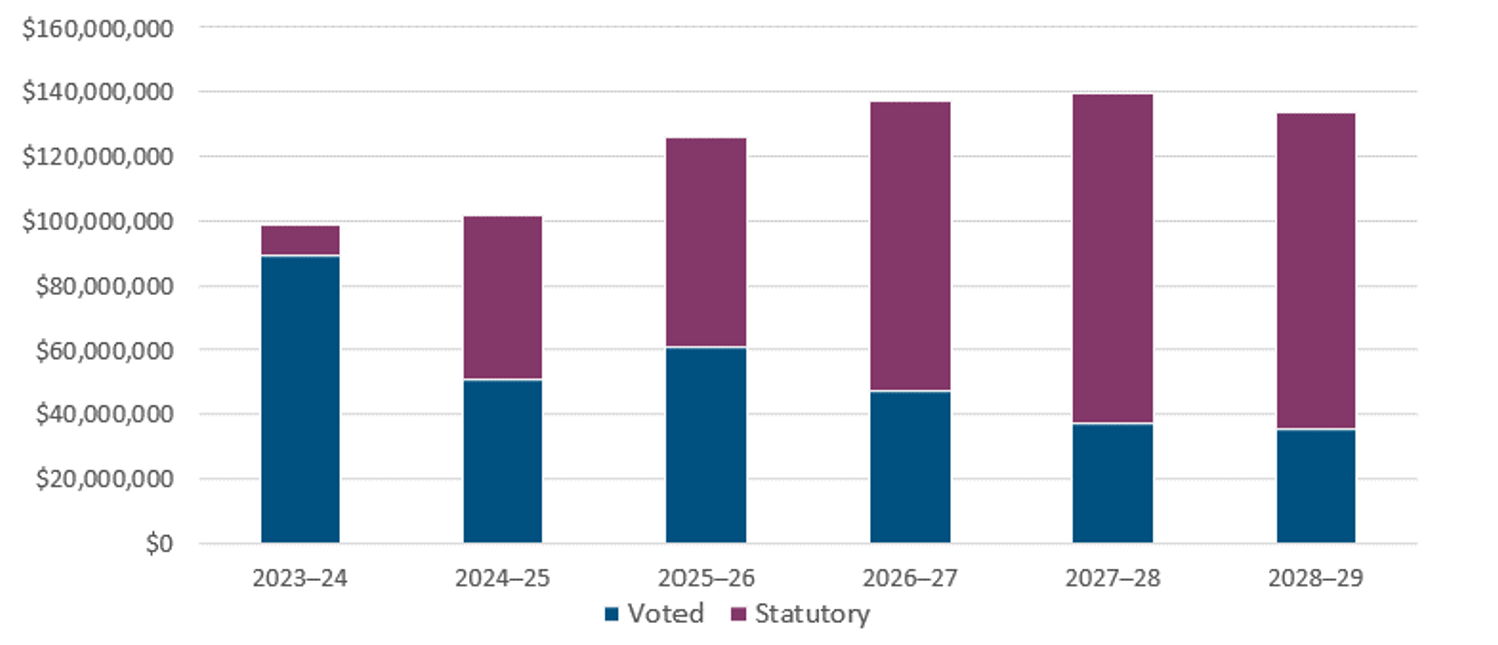
Graph 1: Approved funding (statutory and voted) over a six-year period
Graph 1 summarizes the department's approved voted and statutory funding from 2023–24 to 2028–29.
-
Text description of graph 1
Fiscal year Statutory Voted Total 2023–24 $9,234,462 $89,388,457 $98,622,919 2024–25 $50,623,009 $50,816,019 $101,439,028 2025–26 $65,132,109 $60,750,608 $125,882,717 2026–27 $89,890,642 $47,286,801 $137,177,443 2027–28 $102,371,592 $36,976,997 $139,348,589 2028–29 $98,218,651 $35,182,585 $133,401,236
Analysis of statutory and voted funding over a six-year period
FINTRAC’s funding increased from $98.6M in 2023–24 to $101.4M in 2024–25 primarily due to the funding received in Budget 2024 to enhance FINTRAC's cyber resiliency and ensure the implementation of additional data security safeguards.
FINTRAC's funding is expected to continue to increase to $125.9M in 2025–26 due to the funding profile of investments in Budget 2022 to modernize tools and processes, and Budget 2024 as detailed above.
The expected increase in funding in 2026–27 and 2027–28 is a result of investments required for the Supervision program to address emerging financial crime risks and ensure alignment with national and global priorities.
FINTRAC's funding is expected to decrease to $133.4M in 2028–29 as we move into a stabilization phase after implementing significant modernization initiatives, as well as additional savings attributable to the CER.
For further information on FINTRAC’s departmental appropriations, consult the 2026–27 Main Estimates.
Future-oriented condensed statement of operations
The future-oriented condensed statement of operations provides an overview of FINTRAC’s operations for 2025–26 to 2026–27.
Table 11: Future-oriented condensed statement of operations for the year ended March 31, 2027 (dollars)
Table 11 summarizes the expenses and revenues which net to the cost of operations before government funding and transfers for 2025–26 to 2026–27. The forecast and planned amounts in this statement of operations were prepared on an accrual basis. The forecast and planned amounts presented in other sections of the Departmental Plan were prepared on an expenditure basis. Amounts may therefore differ.
| Financial information | 2025–26 Forecast results | 2026–27 Planned results | Difference (planned results minus forecasted) |
|---|---|---|---|
| Total expenses | $130,060,817 | $143,699,361 | $13,638,544 |
| Total revenues | $60,507,431 | $85,318,027 | $24,810,596 |
| Net cost of operations before government funding and transfers | $69,553,386 | $58,381,334 | ($11,172,052) |
Analysis of forecasted and planned results
Expenses: The variance between the Forecasted and Planned Results amounts is primarily attributed to a $19M increase in planned salary expenditures for the Supervision program. This is offset by an approximate $7M decrease in salary expenditures for the Financial Intelligence Program.
Revenue: The difference from fiscal year 2025–26 to 2026–27 relates to an increase in planned Assessment of Expenses revenue associated to the Supervision program.
Net cost of operations: The $11M difference is primarily due to the increase in total revenues, which is partially offset by a small increase in expenses.
A more detailed Future-oriented statement of operations and associated notes for 2026–27, including a reconciliation of the net cost of operations with the requested authorities, is available on FINTRAC’s website.
Human resources
This section presents an overview of the department’s actual and planned human resources from 2023–24 to 2028–29.
Table 12: Actual human resources for core responsibilities and internal services
Table 12 shows a summary of human resources, in full-time equivalents, for FINTRAC’s core responsibilities and for its internal services for the previous three fiscal years. Human resources for the 2025–26 fiscal year are forecasted based on year to date.
| Core responsibilities and internal services | 2023–24 Actual full-time equivalents | 2024–25 Actual full-time equivalents | 2025–26 Forecasted full-time equivalents |
|---|---|---|---|
| Compliance with Anti-Money Laundering and Anti-Terrorism Financing Legislation and Regulations | 185 | 240 | 264 |
| Production and dissemination of financial intelligence | 134 | 193 | 191 |
| Subtotal | 319 | 433 | 455 |
| Internal services | 218 | 58 | 56 |
| Total | 537 | 491 | 511 |
Analysis of human resources over the last three years
Full-time Equivalents (FTE) decreased from 537 in 2023–24 to 491 in 2024–25. This reduction in FTEs reflects FINTRAC's ongoing efforts to modernize operations by leveraging modern technologies and streamlining processes. FTEs are expected to increase slightly in 2025–26 due to in-flight modernization initiatives.
Table 13: Human resources planning summary for core responsibilities and internal services
Table 13 shows information on human resources, in full-time equivalents, for each of FINTRAC’s core responsibilities and for its internal services planned for the next three years.
| Core responsibilities and internal services | 2026–27 Planned full-time equivalents | 2027–28 Planned full-time equivalents | 2028–29 Planned full-time equivalents |
|---|---|---|---|
| Compliance with Anti-Money Laundering and Anti-Terrorism Financing Legislation and Regulations | 356 | 390 | 381 |
| Production and dissemination of financial intelligence | 156 | 146 | 137 |
| Subtotal | 512 | 536 | 518 |
| Internal services | 69 | 59 | 56 |
| Total | 581 | 595 | 574 |
Analysis of human resources for the next three years
Between 2025–26 to 2027–28, FTEs will increase from 511 to 581 in 2026–27 and increase further to 595 in 2027–28. These increases in FTE levels are attributable to the need for additional resources to support the expansion of the Supervision program, partially offset by the reduction in FTEs resulting from the implementation of savings initiatives as part of the Government of Canada's CER. FTEs will decrease to 574 in 2028–29. This decrease is attributable to the savings from the CER, which will peak in 2028–29, as well as the gradual reduction of planned investments in the modernization of the Supervision program. FINTRAC will be seeking new resources imminently to deliver on its key financial intelligence activities, such as supporting the fight against extortion, and will ensure FTE reductions related to the CER exercise do not conflict with this work.
Supplementary information tables
FINTRAC has no supplementary information tables for the 2026–27 Departmental Plan.
Information on FINTRAC’s departmental sustainable development strategy can be found on FINTRAC’s website.
Federal tax expenditures
FINTRAC’s Departmental Plan does not include information on tax expenditures.
The tax system can be used to achieve public policy objectives through the application of special measures such as low tax rates, exemptions, deductions, deferrals and credits. The Department of Finance Canada publishes cost estimates and projections for these measures each year in the Report on Federal Tax Expenditures.
This report also provides detailed background information on tax expenditures, including descriptions, objectives, historical information and references to related federal spending programs as well as evaluations and GBA Plus of tax expenditures.
Corporate information
Departmental profile
Appropriate minister(s): The Honourable François-Philippe Champagne, Minister of Finance and National Revenue
Institutional head: Sarah Paquet, Director and Chief Executive Officer
Ministerial portfolio: Finance
Enabling instrument(s): Proceeds of Crime (Money Laundering) and Terrorist Financing Act, S.C. 2000, c. 17. (PCMLTFA)
Year of incorporation / commencement: 2000
Departmental contact information
Mailing address
Financial Transactions and Reports Analysis Centre of Canada
234 Laurier Avenue West
Ottawa, Ontario K1P 1H7
Canada
Telephone: 1-866-346-8722 (toll free)
Fax: 613-943-7931
Email: guidelines-lignesdirectrices@fintrac-canafe.gc.ca
Website: https://fintrac-canafe.canada.ca/intro-eng
Definitions
List of terms
- appropriation (crédit)
- Any authority of Parliament to pay money out of the Consolidated Revenue Fund.
- budgetary expenditures (dépenses budgétaires)
- Operating and capital expenditures; transfer payments to other levels of government, departments or individuals; and payments to Crown corporations.
- core responsibility (responsabilité essentielle)
- An enduring function or role performed by a department. The intentions of the department with respect to a core responsibility are reflected in one or more related departmental results that the department seeks to contribute to or influence.
- Departmental Plan (plan ministériel)
- A report on the plans and expected performance of an appropriated department over a 3 year period. Departmental Plans are usually tabled in Parliament each spring.
- departmental result (résultat ministériel)
- A consequence or outcome that a department seeks to achieve. A departmental result is often outside departments’ immediate control, but it should be influenced by program-level outcomes.
- departmental result indicator (indicateur de résultat ministériel)
- A quantitative measure of progress on a departmental result.
- departmental results framework (cadre ministériel des résultats)
- A framework that connects the department’s core responsibilities to its departmental results and departmental result indicators.
- Departmental Results Report (rapport sur les résultats ministériels)
- A report on a department’s actual accomplishments against the plans, priorities and expected results set out in the corresponding Departmental Plan.
- full-time equivalent (équivalent temps plein)
- A measure of the extent to which an employee represents a full person-year charge against a departmental budget. For a particular position, the full-time equivalent figure is the ratio of number of hours the person actually works divided by the standard number of hours set out in the person’s collective agreement.
- gender-based analysis plus (GBA Plus) (analyse comparative entre les sexes plus [ACS Plus])
Is an analytical tool used to support the development of responsive and inclusive policies, programs, and other initiatives. GBA Plus is a process for understanding who is impacted by the issue or opportunity being addressed by the initiative; identifying how the initiative could be tailored to meet diverse needs of the people most impacted; and anticipating and mitigating any barriers to accessing or benefitting from the initiative. GBA Plus is an intersectional analysis that goes beyond biological (sex) and socio-cultural (gender) differences to consider other factors, such as age, disability, education, ethnicity, economic status, geography (including rurality), language, race, religion, and sexual orientation.
Using GBA Plus involves taking a gender- and diversity-sensitive approach to our work. Considering all intersecting identity factors as part of GBA Plus, not only sex and gender, is a Government of Canada commitment.
- government priorities (priorités gouvernementales)
- For the purpose of the 2026–27 Departmental Plan, government priorities are the high-level themes outlining the government’s agenda in the 2025 Speech from the Throne.
- horizontal initiative (initiative horizontale)
- An initiative where two or more federal departments are given funding to pursue a shared outcome, often linked to a government priority.
- Indigenous business (entreprise autochtones)
- Requirements for verifying Indigenous businesses for the purposes of the departmental result report are available through the Indigenous Services Canada Mandatory minimum 5% Indigenous procurement target website.
- non budgetary expenditures (dépenses non budgétaires)
- Non-budgetary authorities that comprise assets and liabilities transactions for loans, investments and advances, or specified purpose accounts, that have been established under specific statutes or under non-statutory authorities in the Estimates and elsewhere. Non-budgetary transactions are those expenditures and receipts related to the government's financial claims on, and obligations to, outside parties. These consist of transactions in loans, investments and advances; in cash and accounts receivable; in public money received or collected for specified purposes; and in all other assets and liabilities. Other assets and liabilities, not specifically defined in G to P authority codes are to be recorded to an R authority code, which is the residual authority code for all other assets and liabilities.
- performance (rendement)
- What a department did with its resources to achieve its results, how well those results compare to what the department intended to achieve, and how well lessons learned have been identified.
- performance indicator (indicateur de rendement)
- A qualitative or quantitative means of measuring an output or outcome, with the intention of gauging the performance of a department, program, policy or initiative respecting expected results.
- plan (plan)
- The articulation of strategic choices, which provides information on how a department intends to achieve its priorities and associated results. Generally, a plan will explain the logic behind the strategies chosen and tend to focus on actions that lead to the expected result.
- planned spending (dépenses prévues)
For Departmental Plans and Departmental Results Reports, planned spending refers to those amounts presented in Main Estimates.
A department is expected to be aware of the authorities that it has sought and received. The determination of planned spending is a departmental responsibility, and departments must be able to defend the expenditure and accrual numbers presented in their Departmental Plans and Departmental Results Reports.
- program (programme)
- Individual or groups of services, activities or combinations thereof that are managed together within the department and focus on a specific set of outputs, outcomes or service levels.
- program inventory (répertoire des programmes)
- Identifies all the department’s programs and describes how resources are organized to contribute to the department’s core responsibilities and results.
- result (résultat)
- A consequence attributed, in part, to a department, policy, program or initiative. Results are not within the control of a single department, policy, program or initiative; instead they are within the area of the department’s influence.
- statutory expenditures (dépenses législatives)
- Expenditures that Parliament has approved through legislation other than appropriation acts. The legislation sets out the purpose of the expenditures and the terms and conditions under which they may be made.
- target (cible)
- A measurable performance or success level that a department, program or initiative plans to achieve within a specified time period. Targets can be either quantitative or qualitative.
- voted expenditures (dépenses votées)
- Expenditures that Parliament approves annually through an appropriation act. The vote wording becomes the governing conditions under which these expenditures may be made.
- Date Modified: